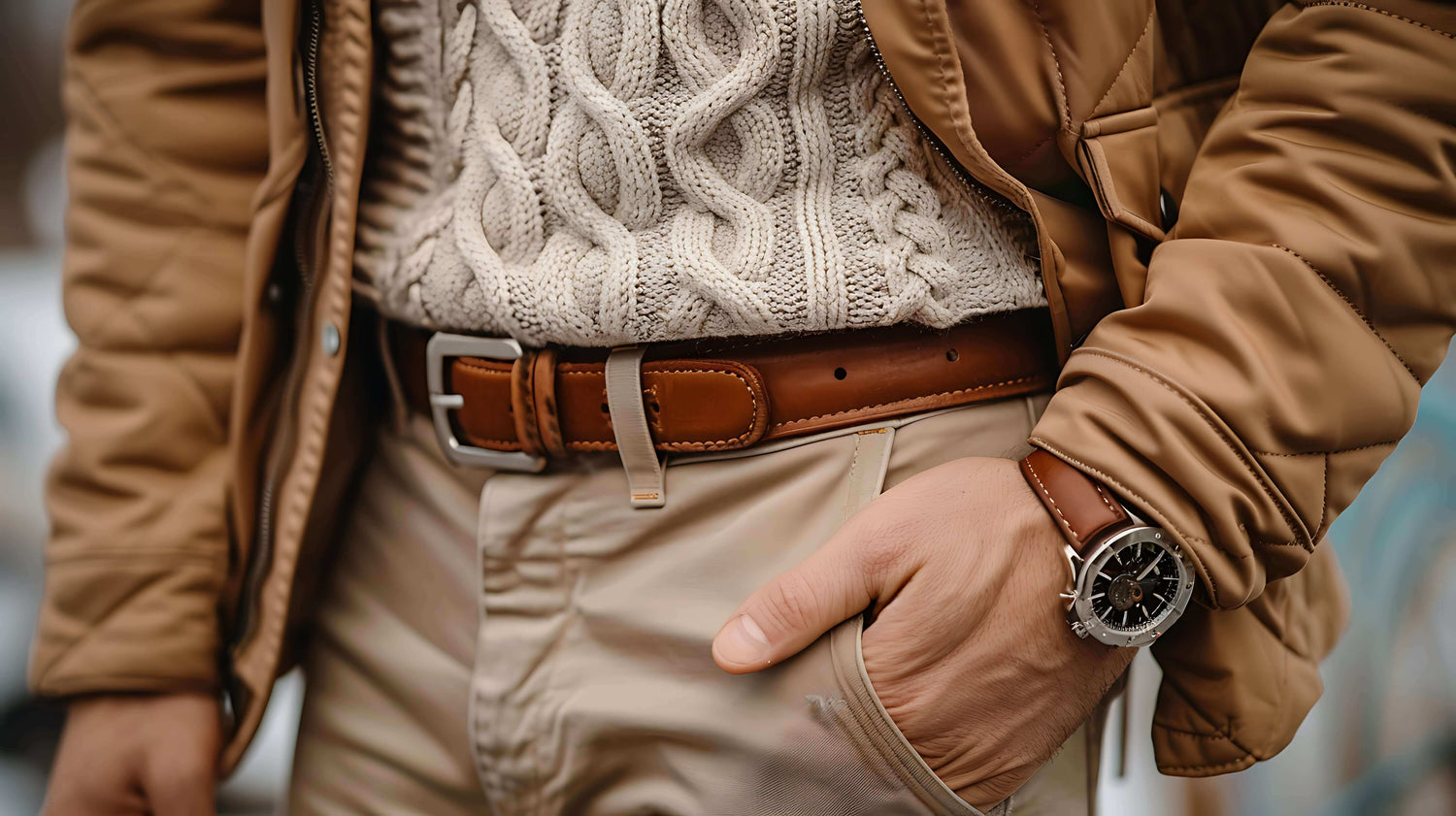


If your belt is curling at the tip, cracking by the holes, or slipping loose halfway through the day, it is not doing its job. A good belt should hold firm, feel comfortable, and still look sharp after months - ideally years - of regular wear. So, how long should a belt last? For most people, a well-made belt should last anywhere from 2 to 10 years, depending on the material, construction, and how often it is worn.
That is a wide range, but belts are not all built the same. A bonded leather belt bought for occasional wear lives a very different life from a full grain leather belt worn five days a week. The same goes for ratchet belts, slide belts and tactical styles, where the buckle system matters just as much as the strap.
How long should a belt last in real life?
For everyday use, a decent leather belt should usually give you 3 to 5 years without much trouble. A premium leather belt, especially one made from full grain or top grain leather, can go far beyond that if it is looked after properly. Some will still be going strong after 7 to 10 years, developing a better texture and richer character as they age.
Ratchet belts and slide belts can also last for years, but their lifespan depends on two parts working together - the strap and the mechanism. If the track system is well engineered and the buckle teeth are made properly, they can outlast traditional pin-hole belts because there is no single hole stretching out under pressure every day. But if the mechanism is cheaply made, the fit can fail before the strap does.
Tactical belts are slightly different again. They are built for support, load-bearing strength and repeated use, often with reinforced webbing or heavy-duty hardware. A solid tactical belt can last several years under hard wear, but if you use it to carry tools or gear every day, expect visible wear sooner than you would on a dress belt.
What actually decides a belt's lifespan?
The biggest factor is material quality. Genuine leather can mean different things across the market, and not all leather is equal. Full grain leather is generally the strongest and longest-lasting because the surface fibre structure remains intact. Top grain leather also performs well and offers a cleaner finish. Bonded leather, by contrast, is made from leftover fibres and adhesives, so it tends to split, peel and fatigue much earlier.
Construction matters just as much. A belt made from a solid piece of leather or a properly layered strap with strong stitching will usually wear better than one glued together with thin facing material. The buckle also deserves attention. Weak buckles, rough-edged clasps and poor fastening points often cause a belt to fail before the strap itself wears out.
Then there is wear pattern. If you rotate between two or three belts, each one gets time to rest and recover its shape. If you wear one belt every single day, especially in the same position and under the same tension, it will naturally age faster.
Body movement and environment also play a part. Long commutes, desk work, driving, heat, moisture and repeated bending all put stress on a belt. A belt worn over heavy denim with constant friction will age differently from one worn over suit trousers in an office.
Why cheap belts fail early
Most belts do not wear out all at once. They usually give you a trail of warning signs first.
With cheaper pin-hole belts, the holes stretch and crack because all the pressure lands on one small point every time you fasten it. The edges start to fray, the finish flakes, and the leather around the buckle fold becomes dry and weak. Once that area breaks down, the belt loses both comfort and structure.
With lower-quality ratchet belts, the issue is often in the buckle rather than the strap. If the internal catch is poorly made, the locking action becomes inconsistent. You start noticing small slips, rough release, or a fit that no longer feels secure. That can make the belt frustrating to wear even if it still looks decent from the outside.
Cheap synthetic belts can hold up for a while if they are only worn occasionally, but daily use usually exposes the weakness fast. Surface coatings crack, backing layers separate, and the whole belt can end up looking tired long before its time.
How long should a leather belt last?
If you are asking specifically how long should a leather belt last, the honest answer is this: a proper leather belt should last years, not months. For regular weekly wear, 3 to 5 years is a fair expectation. For premium leather with good care, 5 to 10 years is realistic.
The kind of leather changes that expectation. Full grain has the best chance of becoming a long-term staple because it resists splitting and tends to age with character rather than collapse. Top grain offers a strong balance of durability and finish. Lower-grade leather can still look good at first, but it often reaches the cracking stage much sooner.
Care makes a difference too. Leather dries out if it is exposed to heat, soaked repeatedly, or left folded awkwardly. Keeping it clean, letting it air naturally, and conditioning it from time to time can add real life to the strap.
Ratchet belts can last longer - if the mechanism is right
One of the biggest advantages of a ratchet belt is the absence of holes. Instead of forcing the prong through the same few spots over and over, the belt adjusts along a track system with small increments. That spreads wear more evenly and gives a more precise fit throughout the day.
For men who sit, stand, drive, and move between work and evening wear, that micro-adjustable comfort is not a gimmick. It reduces pressure points and helps the belt stay supportive without being over-tightened. In many cases, that means less stress on the strap and better long-term wear.
The trade-off is that a ratchet belt depends on the buckle mechanism being properly engineered. If the track is clean, the buckle locks firmly, and the materials are solid, the belt can be an excellent long-wear option. If the mechanism is flimsy, that precision fit will not last.
Signs your belt still has life left
A belt does not need to look brand new to be a good belt. Leather naturally softens, gains texture and shows some shape through use. That is normal. In fact, on a quality strap, a bit of wear can look better than a stiff untouched finish.
What you want to watch for is structural decline rather than surface character. If the belt still holds its shape, fastens securely, and feels comfortable from morning to night, it is doing exactly what it should. Minor creasing near the buckle is expected. Deep cracks, peeling layers, stretched holes or slipping hardware are not.
With tactical belts, fading or slight edge wear may be cosmetic. Loss of rigidity or hardware weakness is more serious. With statement belts, including rhinestone styles, the standard is slightly different. You are also judging finish retention, stone security and how well the design keeps its impact over repeated wear.
How to make a belt last longer
The simplest way to extend belt life is to stop wearing the same one every day. Rotation reduces concentrated wear and helps each strap keep its shape. It also lets you match the belt properly to the occasion - sharper leather for smarter outfits, tactical support for utility wear, and statement pieces when you want more visual punch.
Storage matters more than people think. Hanging a belt or laying it flat is better than leaving it tightly rolled in a drawer for months. If the belt gets wet, let it dry naturally away from radiators or direct heat. Leather and extreme heat are a poor combination.
Clean handling helps too. Wiping off surface dust, avoiding over-tightening, and trimming a ratchet strap correctly if it is designed for custom sizing all reduce unnecessary stress. If the buckle is replaceable, that can add even more life, because the strap and hardware do not always age at the same rate.
At BeltBuy, that is exactly why belt choice matters. A belt is not just there to finish an outfit. It is there to fit properly, wear comfortably, and hold up under real daily use.
When it is time to replace it
Replace a belt when it stops performing, not just when it shows age. If it no longer holds securely, feels uncomfortable, or looks so worn that it drags down the rest of your outfit, it is ready to go. Performance comes first. Style follows close behind.
A belt should earn its place in your wardrobe through fit, support and staying power. If you choose better materials, stronger construction and a design that suits how you actually dress, you can expect a lot more than a single season out of it. Buy for daily life, not just the first impression, and your next belt should feel less like a disposable accessory and more like a dependable part of getting dressed.